The “Events” section of the Tokyo Shitamachi Guide introduces seasonal and limited-time events held in Tokyo’s traditional downtown, known as Shitamachi.
Each article focuses on one recommended event, providing useful information for travelers who want to experience local culture during their trip to Tokyo.
This article features the best free events in the Asakusa area for 2026.
Asakusa is one of Tokyo’s most popular sightseeing areas, and these events are a great way to enjoy the atmosphere without spending money.
If you are visiting Tokyo’s Shitamachi, especially Asakusa, be sure to check them out during your stay.
Please note that event dates and times may change depending on the year or weather.
For the latest and most accurate information, please visit the official website of each event.
- January 2026
- Feburary 2026
- The Asakusa Edo Style Revitalization Project
- Sensoji Temple – Setsubun Festival
- Asakusa Shrine – Setsubun Festival
- Ishihama Shrine – Setsubun Festival
- Otori Shrine – Setsubun Festival
- Torikoe Shrine – Setsubun Festival
- The 13th Oedo Yoshiwara Setsubun Ghost Costume Contest
- Sensoji Temple – Hari-Kuyo Ceremony
- Asakusa Shrine – Kinen-Sai Festival
January 2026
The Bamboo Lantern Festival in East Tokyo
The bamboo light installations, known as Takeakari, create a magical nighttime atmosphere along the river.
Now in its forth year, this popular winter illumination event features even more areas to explore and enjoy.
Locations
- Kitajukken River Terrace (Google map)
- Sumida River Walk
- Sumida Park (Sumida City Side)
- Ushijima Shrine
- Tully’s Coffee Sumida Park
- Tokyo Skytree area
Event Dates
- Friday, November 7, 2025 – Saturday, January 31, 2026
Event Time
- 5:00 p.m. – 10:00 p.m.
Note
For the latest details and updates, please visit the official Takeakari website.
Matsuchiyama Shoden Temple – Daikon Radish Festival
At Matsuchiyama Shoden Temple, there is a long-standing tradition of offering daikon radishes to Daisho Kangiten, the temple’s principal deity.
Daikon radish is a common and important vegetable in Japan. It is believed to aid digestion and help cleanse the body, and it is therefore regarded as a symbol of spiritual purification associated with this deity.
During the Daikon Radish Festival, visitors can enjoy simple dishes made from the daikon that was offered at the temple after New Year’s Day.
Location
- Matsuchiyama Shoden Temple, Taito City, Tokyo (Google map)
Event Date
- Wednesday, January 7, 2026
Event Time
- 11:00 a.m. – 1:30 p.m.
Note
For more information about this event, please see the article “Origin of the Daikon Festival” (in Japanese) on the official Matsuchiyama Shoden Temple website.
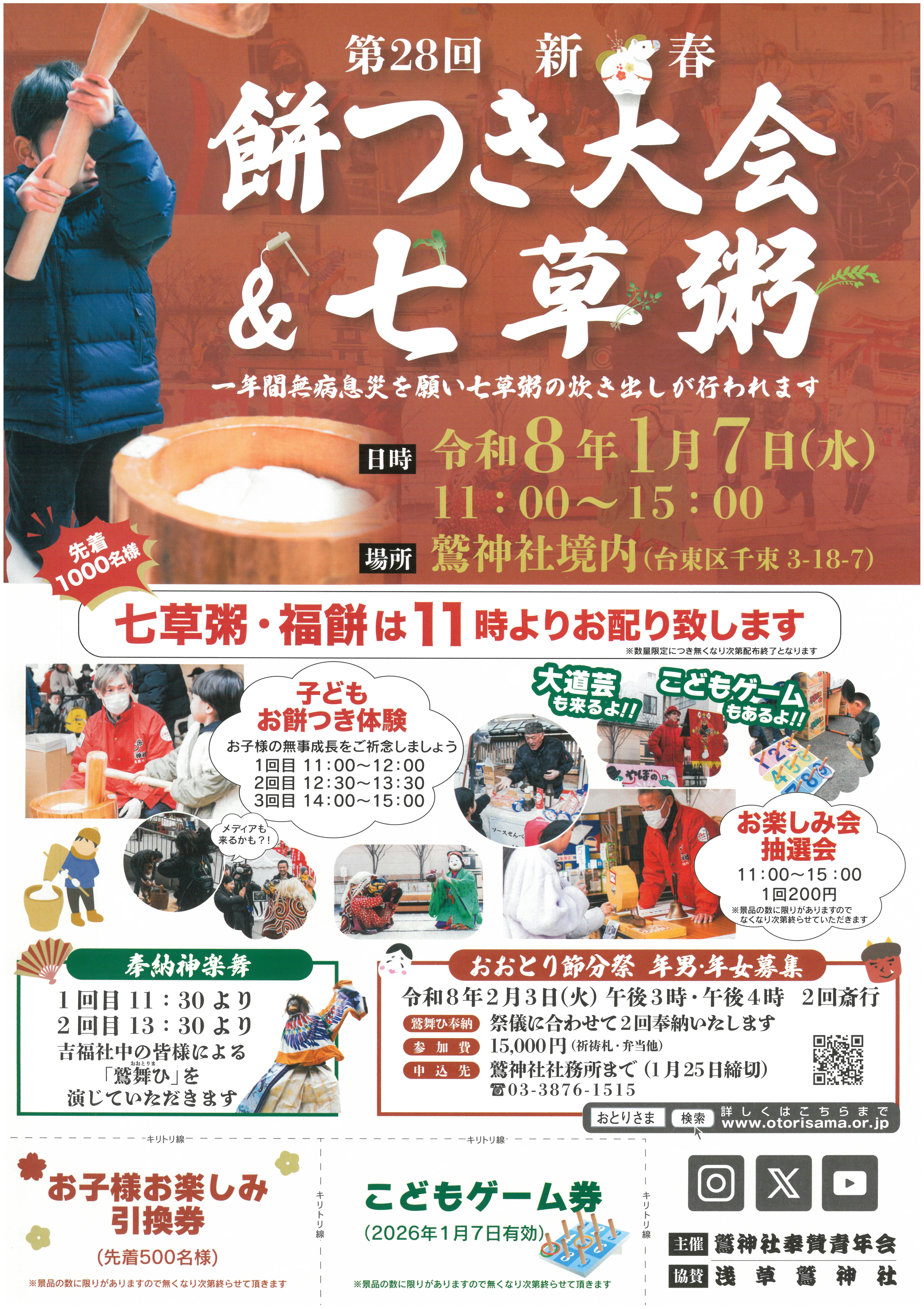
Otori Shrine – New Year Mochi-Pounding and Seven-Herb Rice Porridge
Nanakusa-gayu, or seven-herb rice porridge, is a traditional Japanese dish eaten on January 7. People eat it to pray for good health in the new year.
At Otori Shrine, visitors are offered a bowl of seven-herb rice porridge on January 7 as a prayer for good health throughout the year.
On the same day, there is also a mochi-pounding event. You can watch how mochi (rice cakes) are made, and there are traditional shrine dances called Otorimai as well.
Location
- Otori Shrine, Taito City, Tokyo (Google map)
Event Date
- Wednesday, January 7, 2026
Event Time
- 11:00 a.m. – 3:00 p.m.
Note
For more details about the New Year Mochi-Pounding and Seven-Herb Rice Porridge event, please see the event flyer titled “28th New Year Mochi-Pounding Festival & Seven-Herb Rice Porridge” (in Japanese).
For more information about the Otorimai dance, please check the article “Otorimai” (in Japanese)” on the official Otori Shrine website.
Sensoji Temple – Sending Off the Spirits Ritual
Sensoji Temple holds a special Buddhist ritual called Onza Hiho Darani-e every January.
The purpose of this ritual is to calm evil spirits and to pray for peace in Japan and around the world.
During the ritual, prayers are chanted 168 times over seven days. Moja Okuri, or the “Sending Off the Spirits,” is the final prayer of the ritual.
At the climax of the ritual, two monks dressed as demons walk around the temple grounds. This dramatic scene is very powerful and impressive to watch.
Location
- Sensoji Temple, Taito City, Tokyo (Google map)
Event Date (Scheduled)
- Sunday, January 18, 2026
Event Time (Scheduled)
- 5:00 p.m.
Note
For more details about the Sending Off the Spirits ritual, please see the article “Onza Hiho Darani-e” (in Japanese) on the official Sensoji Temple website.
Asakusa Shrine – Hatsuka Ebisu Festival
Asakusa Shrine enshrines Ebisu, a deity of good business, prosperity, and family safety.
The Hatsuka Ebisu Festival marks the first Ebisu day of the year. It is said that praying to Ebisu on this day brings especially strong blessings. Many people visit the shrine to pray for good luck in the New Year and success in business, making it a lively and festive event.
On the festival day, visitors can receive special limited-edition shrine stamps (goshuin) and lucky bamboo branches called fukuzasa, which are believed to bring good fortune. It is a wonderful opportunity to experience Japanese New Year traditions and shrine culture while sightseeing in Asakusa.
Location
- Asakusa Shrine, Taito City, Tokyo (Google map)
Event Date (Scheduled)
- Monday, January 19, 2026 – Tuesday, January 20, 2026
Event Time (Scheduled)
- 9:00 a.m. – 5:00 p.m.
Note
Feburary 2026
The Asakusa Edo Style Revitalization Project
The Asakusa Edo Style Revitalization Project brings the spirit of old Tokyo to life in the Okusasakusa area, just behind Sensoji Temple.
During the event, the grounds of Asakusa Shrine and Fujidori Street are beautifully lit with traditional lanterns, and visitors can enjoy a variety of activities, including events inspired by classic ukiyo-e woodblock art.
Locations
- Asakusa Shrine, Taito City, Tokyo (Google map)
- Asakusa Fuji Sengen Shrine, Taito City, Tokyo (Google map)
- Fujidori Street, Taito City, Tokyo (Google map)
- Others
Event Dates
- Sunday, Feburary 1, 2026 – Saturday, March 14, 2026
Event Time
Note
For the latest details and updates, please visit the official The Asakusa Edo Atmosphere Creation Project website.
Sensoji Temple – Setsubun Festival
Setsubun originally means “the turning point of the seasons.” In Japan, there are four such seasonal changes each year, and among them, the one in early February is especially important as the first Setsubun of the year.
For a long time, people have believed that evil spirits are more likely to appear at these turning points, bringing illness and bad luck. That’s why, on Setsubun in February, people throw beans at “oni” (demons), which represent these bad spirits, to drive them away and pray for happiness and good health in the coming year.
At Sensoji Temple’s Setsubun Festival, visitors can enjoy lively bean-throwing ceremonies led by the “lucky men” of the year and celebrities. One of Sensoji’s three traditional temple dances, the Fukuju no Mai (Dance of the Seven Lucky Gods), is also performed, creating a festive and joyful atmosphere full of good fortune.
Location
- Sensoji Temple, Taito City, Tokyo (Google map)
Event Date (Scheduled)
- Tuesday, February 3, 2026
Event Time (Scheduled)
- Noon (Buddhist ritual)
- 0:30 p.m. (Fukuju no mai)
- 2:00 p.m. (Buddhist ritual)
- 2:30 p.m. (Fukuju no mai)
- 4:00 p.m., 4:20 p.m., 4:40 p.m. 5:00 p.m. (Bean-throwing ceremony)
Note
For more details about the Setsubun Festival, please see the article “Setsubun-e” (in Japanese) on the official Sensoji Temple website.
Asakusa Shrine – Setsubun Festival
Location
- Asakusa Shrine, Taito City, Tokyo (Google map)
Event Date (Scheduled)
- Tuesday, Feburary 3, 2026
Event Time (Scheduled)
- 2:30 p.m. (Shinto ritual)
- 3:00 p.m. (Kagura-mai)
- 3:30 p.m. (Bean-throwing ceremony)
Note
For more information about this event, please refer to the article “Setsubun Festival 2026” (in Japanese) on the official Asakusa Shrine website.
Ishihama Shrine – Setsubun Festival
Location
- Ishihama Shrine, Arakawa City, Tokyo (Google map)
Event Date (Scheduled)
- Tuesday, Feburary 3, 2026
Event Time (Scheduled)
- 3:30 p.m. (Shinto ritual)
- 4:00 p.m. (Bean-throwing ceremony)
Note
For more details about Ishihama Shrine’s Setsubun Festival, please refer to the article “Setsubun Festival 2026” (in Japanese) on the official Facebook page.
Otori Shrine – Setsubun Festival
Location
- Otori Shrine, Taito City, Tokyo (Google map)
Event Date (Scheduled)
- Tuesday, Feburary 3, 2026
Event Time (Scheduled)
- 3:00 p.m.
- 4:00 p.m.
Note
For more information about this event, please refer to the article “Setsubun Festival” (in Japanese) on the official Otori Shrine website.
Torikoe Shrine – Setsubun Festival
Location
- Torikoe Shrine, Taito City, Tokyo (Google map)
Event Date (Scheduled)
- Tuesday, Feburary 3, 2026
Event Time (Scheduled)
- 3:40 p.m. (Shinto ritual)
- 4:00 p.m. – 6:00 p.m.
Note
The 13th Oedo Yoshiwara Setsubun Ghost Costume Contest
Location
- Hanazono Park, Taito City, Tokyo (Google map)
Event Date (Scheduled)
- Sunday, February 8, 2026
Event Time (Scheduled)
- Noon to 4 p.m.
- 1:00 p.m. (the contest)
Note
For more information about this event, please refer to the official website (in Japanese.)
Sensoji Temple – Hari-Kuyo Ceremony
Awashima Hall at Sensoji Temple, is dedicated to Awashima Myojin, a guardian deity for women. This deity is especially known for blessings related to improving sewing and needlework skills.
Every year on February 8, Sensoji holds a special event called Hari-kuyo, a memorial service to thank old needles for their service. During the ceremony, broken or rusty needles that have finished their role are gently placed into soft tofu as an offering.
People express their gratitude to the tools that supported their sewing and handiwork, and pray for safety and improvement in the future. Hari-kuyo is a warm, uniquely Japanese tradition that reflects a deep respect for everyday objects and the care put into making things by hand.
Location
- Awashima-Do Hall at Sensoji Temple, Taito City, Tokyo (Google map)
Event Date (Scheduled)
- Sunday, February 8, 2026
Event Time (Scheduled)
- 6:30 a.m. to 5:00 p.m.
- 11:00 a.m. (Buddhist ritual)
Note
For more information about this event, please refer to the article “Harikuyo” (in Japanese) on the official Sensoji Temple website.
Asakusa Shrine – Kinen-Sai Festival
Kinen-sai is a spring Shinto ritual held before the rice-planting season. People pray for a rich harvest, as well as for peace and safety in the nation, the local community, and everyday life.
At Asakusa Shrine, the festival features a graceful miko-mai (sacred dance performed by shrine maidens) offered to the gods. The shrine grounds are filled with a calm, pure atmosphere, and visitors can also receive a special, limited-edition goshuin (shrine stamp) made just for this occasion.
Location
- Asakusa Shrine, Taito City, Tokyo (Google map)
Event Date (Scheduled)
- Tuesday, February 17, 2026
Event Time (Scheduled)
- 10:00 a.m. (Shinto ritual)
Note
For more information about this event, please refer to the article “Kinen-Sai Festival” (in Japanese) on the official Asakusa Shrine website.